
I. What Happened? What Happened Next? So What?
In my experience, literary discussions in the high school classroom can easily get stuck in questions about “what happened.” What did this character do? How did this other character respond? Then what happened? These questions are good because they help students establish context, demonstrate comprehension, and catalogue important details, which are all important skills. Moving past these skills and toward other questions, though, can be difficult. Ask something like, What greater significance is suggested here?, and students are likely to clam up and avoid all eye contact. The answers to these questions, after all, are often implicit, ambiguous, and complex. The chasm between the objectivity of “what happened” and the subjectivity of “why it matters” makes for a great cognitive leap. So: how do you get students — especially high school students, whose attention is so easily diverted toward more immediate and personal concerns — to bend their knees and jump?
Encouragement is nice, but it only goes so far. A teacher can say, think more deeply or what is the author really trying to say here, or, in moments of desperation, model a form of interpretation by assembling each student’s halting, fragmented response into a coherent thematic statement. But the real goal, of course, is to get students observing, synthesizing, and interpreting all on their own.
So, here are two conceptual tools that I make available to students. The virtue of these tools is that they are somewhat precognitive or instinctual. That is, students who use them will begin developing an interpretation with their gut responses — a safe and easy place from which to start. Instead of blindly leaping the chasm from summary to analysis, they build a bridge out of some very simple materials that are ready at hand. And, to me at least, these tools seem, for lack of a better word, authentic. They are tools that I use frequently when I’m reading, listening to music, or looking at art — even when I am doing these things, as they say, “for pleasure.”
II. The Ladder of Abstraction
The first tool is a version of S. I. Hayakawa’s concept of the “Abstraction Ladder,” which looks like this:
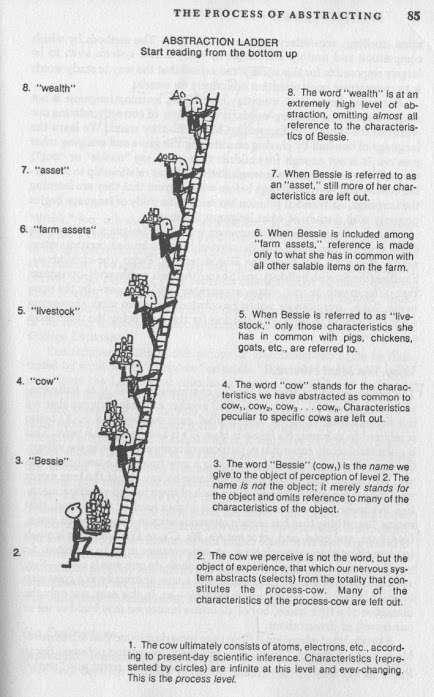
The idea here is relatively simple: every concrete object of experience — a cow, a pen, a slice of pizza — can be referenced at different levels of abstraction in a continuum that runs from “concrete” to “conceptual.” Hayakawa illustrates this with the example of a cow. If, as I drive through farmland on my way to work, I see a cow in the field, I may think to myself: “hey, there’s a cow, how bucolic and pretty.” I see a specific cow with specific features, doing a specific thing in a specific moment, and I have a reaction. Simple. The linguistic part of the experience is that I observe a cow and think “cow.” That’s pretty concrete, so we might say that I’m just a couple of rungs up the ladder of abstraction and nowhere near the top. (I could park my car, walk up to the cow, discover a nametag on its cowbell that says “Bessie” — and now I’m processing this bovine object of my experience at, ladder-wise, a lower and even more concrete level.)
But if I go up the ladder of abstraction, I end up moving away from Bessie the cow and toward a broader conceptual framework of which Bessie is a part. Bessie doesn’t exist in a vacuum, after all, but in the world of the farm. So, Bessie becomes subsumed by categories that include both Bessie and other things as well. As I climb the ladder of abstraction, I go from Bessie the cow to cows more generally, then livestock, then farm assets, then assets, then wealth — as shown in the illustration above.
This is not so hard to practice with students. Write the word “pizza” on the board, ask students to go three “rungs” up the ladder and three “rungs” down, and, without much prodding, you usually get something like this:
- SUSTENANCE
- FOOD
- ITALIAN FOOD
- –PIZZA–
- PEPPERONI PIZZA
- PEPPERONI PIZZA FROM DOMINO’S
- LAST WEEK’S LEFTOVER PEPPERONI PIZZA FROM DOMINO’S THAT IS GROWING MOLD IN MY REFRIGERATOR
What does any of this have to do with literature? Well, the concrete details of a story — the characters, their dialogue, the images and uses of figurative language, and all of the granular “facts” or “elements” on the page — can reasonably be connected to more thematic and abstract ideas that have relevance outside the enclosed fictional world in which they exist.
Say, for example, that our story features a ranch worker who tends to the horses and mends equipment all day; at night, he reads from a copy of the California civil code for 1905. Those are the concrete, low-rung details on the page. Go up the ladder of abstraction, though, and link the concrete fact of “tends to the horses” to the abstraction of “physical labor,” and the concrete “California civil code” to the abstraction of “individual rights.” What we discover, maybe, is a tension between physical labor and the protections of the law. What does one thing have to do with another? Perhaps the story will help us answer. And answering that question is the beginning of a literary interpretation. Suddenly, by climbing Hayakawa’s ladder, we’re talking about bigger ideas that relate more dynamically to our shared world of lived experience.
III. The Circle of Interpretation
Of course, “the ladder of abstraction,” as a conceptual tool, doesn’t always get the job done. I remember, for example, trying to launch a discussion about Robert Frost’s poem “The Silken Tent”:
She is as in a field a silken tent
At midday when the sunny summer breeze
Has dried the dew and all its ropes relent,
So that in guys it gently sways at ease,
And its supporting central cedar pole,
That is its pinnacle to heavenward
And signifies the sureness of the soul,
Seems to owe naught to any single cord,
But strictly held by none, is loosely bound
By countless silken ties of love and thought
To every thing on earth the compass round,
And only by one’s going slightly taut
In the capriciousness of summer air
Is of the slightest bondage made aware.
I’ve been reading this poem for decades, and it conjures for me a specific type of person: the family matriarch. I see the poem as a tribute to a sturdy, pious, loving, dependable mother who has sheltered her people in a secure home governed by faith and tradition. The poem’s insight, I think, is that love enlivens and protects us while it also binds us, ties us down, restricts us — and there is, the poem suggests, a kind of paradoxical beauty in this tension. There are other ways to understand the poem, or other dimensions to this particular understanding, but I land here every time I read it.
Years ago, I had this one class that insisted, with obstinate unanimity, that the proper way to go “up the ladder of abstraction” was to see “silken ties” and “bondage” as concrete examples of a sexual fetish. Suddenly, the image I had of a kind, nurturing woman grounded in her faith was conflated with … a dominatrix for hire. Sensing my discomfort, the students pounced: yes, they said, the poem was definitely about a prostitute, not a churchy mom! (Just look at all of the “guys” she’s swaying with — and no, it does not matter if “guys” in this context means “ropes”!)
My reaction? No, no, no, no, no. But how could I fault these students? And on what grounds could I correct them? They had, after all, done the kind of abstracting I’d asked them to do. They’d climbed the ladder.
So, we need another conceptual tool. Which brings us to something we might call the Circle of Interpretation.
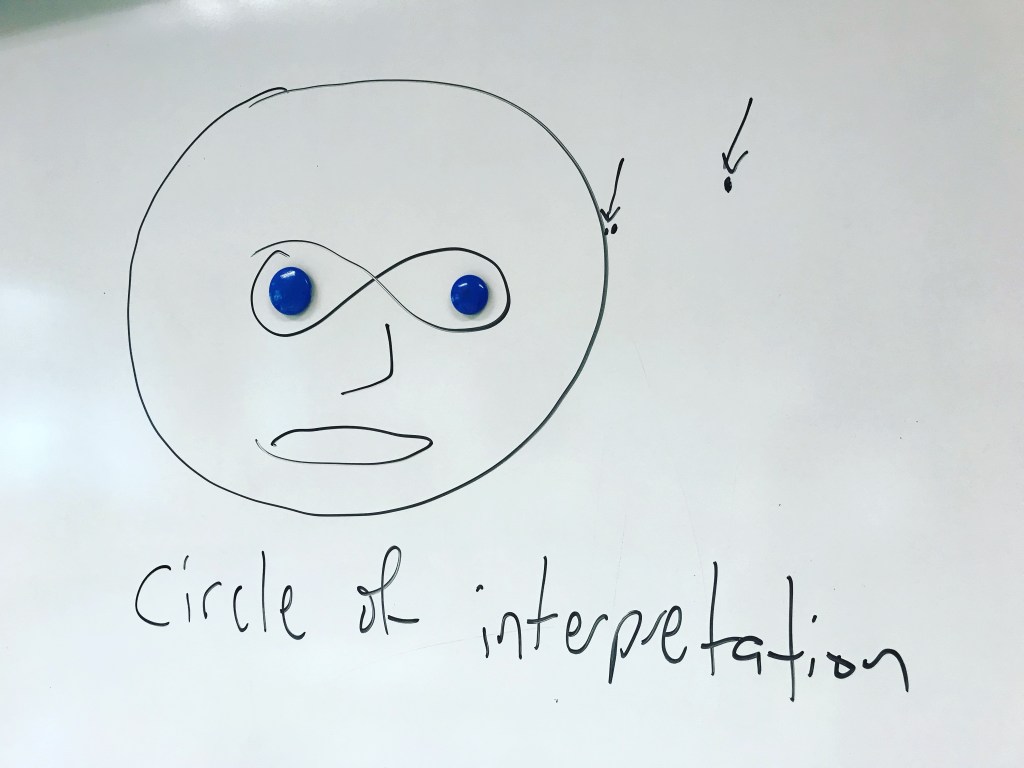
Whenever a student offers an egregiously implausible interpretation (“Frost’s sonnet celebrates kinky bondage”), I draw a circle on the board and label it “Circle of Interpretation.” The idea is simple: any interpretation we offer can be considered valid and placed within the circle of interpretation if it meets one very basic condition: the interpretation has to actually use the concrete “stuff” of the text. (Or, in other words, it has to use the lower rungs of the abstraction ladder.)
If, for example, the narrator of The House on Mango Street says, “I am a red balloon, a balloon tied to an anchor,” and a student responds, “Ah-ha! This simile reveals a fear of clowns because Pennywise has a red balloon in Stephen King’s It” — well, we’d have to go looking for other “clown stuff” in the text to see if this interpretation gains any traction. If there’s no other “clown stuff,” and if the material on the page actively suggests loneliness and obligation as driving elements of a sibling relationship, then we probably shouldn’t put “fear of clowns” in the circle of interpretation. Even if there is a chapter called “Red Clowns” some 90 pages later, it seems unlikely that “fear of clowns” is the point of this particular simile. (Also, Mango Street was published before It.)
Somehow, the mere act of drawing the circle and then asking the class what belongs inside or outside does the trick: the weird, hazy task of interpretation is now graphically delineated. Most students won’t abide an absurdly transgressive interpretation. One’s place in the circle must be earned, and earned primarily from the text. It’s okay to be clever, it’s even okay to be associative and speculative and tentative — so long as the text continues to play along.
So, if we go back to “The Silken Tent,” the one concrete element of the poem that the students ignored was the “supporting central cedar pole” which is the “pinnacle to heavenward” and “signifies the sureness of the soul.” (How rare is it for a poem to announce the meaning of its own symbols?) Here, the speaker tells us that the woman’s soul is sure, that it reaches toward heaven. She is confident, grounded, unwavering, and oriented toward divinity. To argue that the poem is about a sexual fetish is to disregard its own carefully explicated use of figurative language. (For all that, I never did win the pious mother/S&M prostitute debate. Those students wouldn’t budge. They saw that I cared too much.)
It’s worth noting that the “circle of interpretation” is based on the idea of the “hermeneutic circle,” which, besides showing how the different parts of a whole reinforce the whole, also connects the different details of a text with their historical or cultural context. For example, it’s easy to enjoy Animal Farm without knowing that Napoleon and Snowball are allegorical figures for Stalin and Trotsky, but they clearly are, and Orwell expects the reader to arrive with enough outside knowledge to identify the historical corollaries.
In other words, the circle of interpretation doesn’t seal the text off from the world. The world always breaks in because art is made in and about the world. If I read in a novel that “Frank ate the bread and drank the wine,” it’s all but impossible to avoid thinking of Christ at the last supper. Does this mean that Frank is some metaphorical incarnation of Christ? Maybe, maybe not — it depends on what else the text is doing, and even then there will be ambiguity. But the association is there, open, invited, ready for identification. And, because each reader’s mind is shaped in a particular way, stuffed with a unique set of life experiences, refined by some alchemy of nature and nurture, and equipped with a whole host of biases and predilections, the text reverberates differently for each reader. The question for us in the classroom is, does the text (or work of art, or piece of music) accommodate this particular reading, or does it resist?
For better or worse, these notions about abstraction and interpretation are baked into my worldview. I can hardly read the back of a box of Cheerios without climbing the rungs of Hayakawa’s ladder, and I frequently blow the whistle (in my mind, anyway) on arguments and interpretations that have illegitimately crossed into the circle of interpretation when they belong on the outside. (I can’t even tell you how many sermons I’ve heard where half a dozen scriptures from different books of the Bible were stitched into some unholy garment to dress a harebrained prophecy that, surprise, never came true.)
V. Don’t Worry About the Government
About a dozen years ago, an older colleague encouraged me to go back to the 1970s and listen to the music of that decade. He thought that I overvalued the late work of artists who had been much better, more daring and original, earlier in their careers. In particular, he encouraged me to listen to Talking Heads: 77. So I did, and it was good stuff, funkier than their later work, which I knew better. Listening for the first time, I liked it, but it wasn’t blowing open any doors for me.
Then I heard the eighth track on the album: “Don’t Worry about the Government.”
Have a listen — and, since I ended up turning this song into an assignment for my Advanced English classes, consider paying attention to the lyrics, too:
I became obsessed with this song. It’s so catchy, so sing-song and childlike in its simplicity, and the lyrics are both ordinary and, well, really weird. “Don’t Worry about the Government” gets into your head — or it gets into mine, at least. At the time, I couldn’t stop listening to it, and I kept wondering: who is this guy, anyway? Not David Byrne, but the persona he took for the song, this guy who is grateful for his building, a building where he can get his work done, work that he will put down when visited by his loved ones, loved ones who remind him of government employees who develop laws, laws good enough to count as his “favorites.” To me, it seems as if the song is written and performed by an extraterrestrial of average intelligence who’s observed human behavior for a couple of weeks but doesn’t fully understand the way we make distinctions between the professional and domestic spheres of our lives.
One great thing about teaching is that, when I develop a mild obsession about a piece of art, music, or literature, I can usually find a way to put it in front of students — and that’s what I did with “Don’t Worry about the Government.” I distributed the lyrics, played the song, and asked the question: What is that, anyway?
Well, start low on the abstraction ladder: it’s a pop song from the seventies.
Good! But what about all of its distinct and specific parts — the drum fills, the tempo, the vocals, the lyrics, these many concrete elements of the song? What about the lyrics that these elements lift up and support? What does it all add up to? Maybe what we’re really asking is something like: how does this song function? What does it do? And can we try to distill its function into a single sentence that captures the essence of the song and all of its tensions at an abstract level?
Maybe we can — or we can try. Here are some of the responses students have offered over the years:
Talking Heads’ “Don’t Worry about the Government” is …
- a celebration of life’s conveniences in a technologically advanced society.
- a reflection on the loss of nature’s beauty to human productivity.
- a depiction of the robotic work ethic necessary for success in a capitalist culture.
- a satire about modern consumerism and political complacency.
- a caution against the growing influence of the federal government.
- a warning about the danger of repressing negative emotions.
- a psychological glimpse into the monotonous mind of office workers.
- an endorsement of the freedoms granted by a free market economy.
- a critique of the diminishing force of domestic and social life.
- a silly song with nonsense lyrics and a catchy tune.
- some combination of the above!
All of these possibilities belong, I think, inside the circle of interpretation — some of them require further explication, yes, and some of them contradict others. But for every “legitimate” interpretation put forth here, there are dozens of “illegitimate” ones. You could not reasonably suggest, I think, that “Don’t Worry about the Government” is an indictment of feminism’s failure to produce equitable outcomes for women, or that it’s a rallying cry for vegetarianism, or that it’s a plea to spay one’s pets. There are so many things that this song simply ignores. But it does seem to be making some kind of comment, ironic or sincere, about 1) governments and laws, 2) worker productivity, 3) housing, 4) family and friends, and 5) nature. To the degree that we can “interpret” this piece of music and say that it’s “about” anything, it would have to be about these things and not other things. (Probably. Conspicuous absences signify, too. Consider Lady Macbeth’s baby or Hedda Gabler’s mother.)
Over the years, it’s been instructive to watch students “test drive” some of their interpretations by racing them back through the song. I’ve listened to students argue about the way David Byrne sort of warbles the last word of the song, that final high-pitched “Don’t you worry ’bout MEEEEEEEEEE!” Perhaps he doth protest too much? Should we be worried about him, after all? Or should we be assured and bop along to this happy tune? So much, we discover, hinges on a question like: is this satirical or sincere?
And so on. But the point is this: at least now, talking this way, asking these questions, we aren’t stuck in a conversation about “what happens and then what happens next.” Going up and down the ladder of abstraction, grabbing the details we find on the ground and climbing toward broader and more inclusive concepts — this is the stuff of literary analysis, and what makes it both creative and fun while also being, if I can insist on this, important. Creative because our own personal reactions guide us toward what we find interesting, where we have to toss around ideas until something strikes us as good. Fun because we keep revising our assumptions as we reconceptualize the connections between the concrete and the abstract, which usually produces an ah-ha moment, a discovery. Important because, well, meaning-making through narrative is what humans essentially do, and the active readers among us keep something for themselves after the book or song has ended.
 Every Third Thought